
Walk into any professional training ground 75 minutes before kickoff and you'll see the same scene: players drifting onto the pitch in small groups, some carrying resistance bands, others arguing about the order of the activation drills. It looks casual. It isn't. The football pre-match warm-up has become one of the most scrutinized segments of the weekly microcycle, and for good reason — get it wrong and you're chasing the game from the first whistle.I spent a season tracking warm-up routines at a Championship club, and the data was blunt. Players who completed the full 22-minute sequence — mobility。neural priming, ball work, then a short, sharp sprint block — covered 8% more high-intensity distance in the opening 15 minutes than those who rushed through it. The difference wasn't fitness. It was readiness. A proper football pre-match warm-up does three jobs at once: it raises muscle temperature without frying the legs, it rehearses the specific movement patterns of the game, and it switches the brain on to scanning and decision-making.Skip the neural priming and you'll see it in the first five minutes. A centre-back who hasn't done any reactive agility work will be half a yard slow to a bouncing ball over the top. A winger who hasn't touched a ball at speed will take a heavy first touch. These aren't fitness failures;
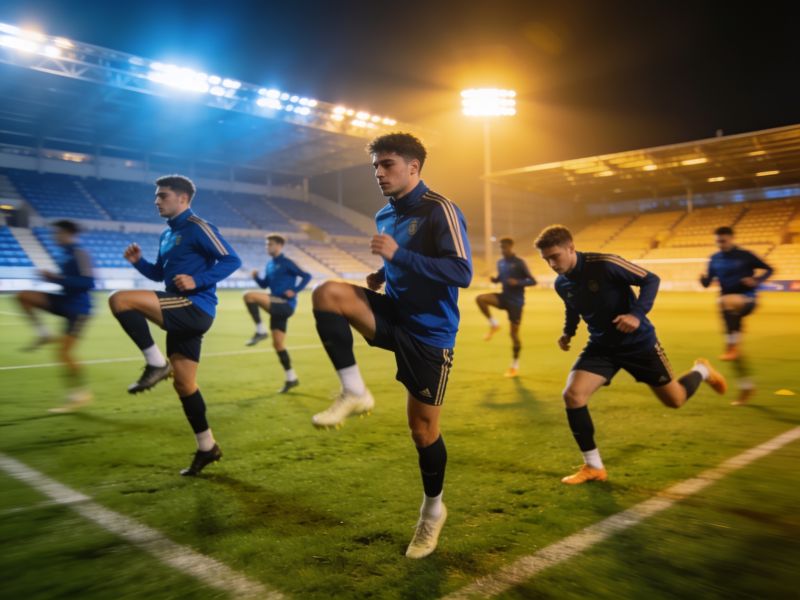
they're preparation failures. I watched a veteran midfielder — 34 years old, maybe 15 minutes of high-intensity running left in the tank on a good day — insist on a 6-minute rondo before every match. His reasoning was simple: "I need to see the ball moving before the whistle blows. Otherwise my first pass is a guess." He was rarely dispossessed in the opening half-hour. That's not luck.The structure that works, in my experience, is roughly 25 minutes of deliberate work. Start with 5-6 minutes of dynamic mobility — hip openers。leg swings, some light skipping. Then 5 minutes of activation: glute bridges, band walks, a few short accelerations at 70% effort. The ball comes out for 8-10 minutes of possession and passing patterns that mirror the team's shape. Finish with 3-4 sharp sprints and a couple of long-range strikes to engage the nervous system. Total time: under 25 minutes. Anything longer and you're borrowing energy from the first half.One detail that gets ignored: the warm-up never really ends. The first three minutes of the match are an extension of it — the body is still finding its rhythm, the brain is still calibrating. Teams that treat the whistle as a hard stop often concede early. Those that ease into the game with simple, safe passes for the first 90 seconds tend to grow into it. The best football pre-match warm-up I saw all season was almost boring: no fancy drills, no shouting。just players moving through a routine they could do in their sleep. Predictable preparation breeds calm execution. That's the whole point.